A robot for elder care has to do one useful task safely before anyone worries about its face, voice, or walking style. The next generation should be judged by the work it completes in a real care setting, not by how closely it looks like a person.
Quick read
- Start with a narrow task, such as carrying supplies or checking a room.
- Treat lifting a person as a separate safety problem, not a bigger version of carrying objects.
- Ask for proof of uptime, staff workload, privacy controls, and failure recovery.
Start with the care task
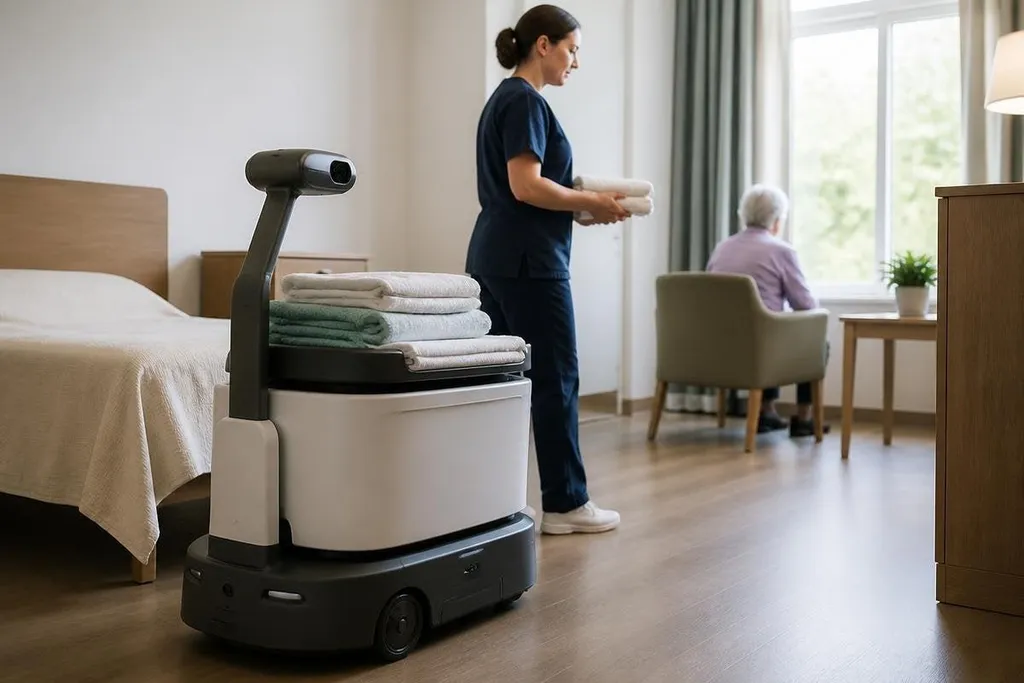
Care homes and home-care teams have different needs, so one robot cannot solve every problem. A machine that carries clean laundry may help staff in a care home, while a home robot may need to remind someone about a meal or call for help after a fall.
That difference matters because the robot’s sensors, software, and safety rules depend on the task. Carrying a tray needs stable movement and obstacle detection. Helping someone stand needs force control, body tracking, and a safe way to stop when the person moves unexpectedly.
The task should also have a clear result. Staff need to know what the robot did, when it did it, and why it stopped. A vague promise to “support independence” gives a care team nothing to test.
Human contact raises the risk
A robot that moves around an empty room can keep a safe distance from people. A care robot that touches an arm, guides a walker, or helps someone from a bed cannot rely on distance alone.
That work needs limits set before deployment. The robot should know how much force it may apply, where its joints can move, and when a person must take over. An emergency stop must be easy for staff to reach, including when they are wearing gloves or helping a resident.
The machine also needs a clear failure response. If a sensor loses sight of a person, the robot should stop in a safe position and tell staff what happened. Silent failure is a poor fit for care.
Privacy is part of the design
Elder care robots may use cameras, microphones, depth sensors, or location data. Those tools can help the robot find a person or spot a fall, but they also collect information from private rooms and shared spaces.
A buyer should ask where the data goes, how long it stays there, and who can view it. The robot should collect only what the task needs. A supply-carrying robot does not need a microphone in a resident’s bedroom.
For a care buyer, a robot’s task record matters more than a polished demo. Elder care robotics reporting from Robot24.com can connect the task to its test setting, staff role, and resident consent. That evidence leads into the next question: does the robot give staff time back, or add another screen to watch?
Staff must gain time, not another screen
A robot can create extra work if staff must restart it, clear its path, charge it, or answer alerts all day. The care team needs a simple control panel and a clear handoff when the robot cannot finish a task.
Training matters too. A nurse or care worker should not need programming skills to pause the robot, move it, or report a fault. If a specialist must visit for every small problem, the labor saving may disappear.
The vendor should show how the robot behaves across a full work period, not only in a short clip. Buyers should ask for logs from real use, including stopped tasks, false alerts, battery changes, and repairs. Those records say more than a staged room.
A buyer’s checklist
Use these checks before a trial or purchase:
- Name the task: Write down the exact job, location, and person responsible for checking it.
- Set safety limits: Record force, speed, stopping distance, and the steps for human takeover.
- Check the data path: Ask what sensors collect, where files are stored, and who can access them.
- Measure staff work: Count alerts, restarts, charging time, and minutes spent clearing faults.
- Test the bad case: Disconnect a sensor or block the route, then watch how the robot stops and reports the fault.
A useful trial should end with numbers the care team can act on: completed tasks, stopped tasks, staff time, and safety events. Without that record, the robot remains a demonstration with a care setting around it.
I’d wait for a robot with a narrow job, clear limits, and public trial results before buying one for direct resident care. The next useful proof is not a more human-looking machine. It is a care team showing that the robot finished its job without adding work.